|
|
|
|
|
|
|
|
|
| |||||||||||||||||||||||||||||||
| ||||||||||||||||||||||||||||||||||||||||||||||||||||||||||||||||||||||||||||||||||||
| Signatures on this item | |
| *The value given for each signature has been calculated by us based on the historical significance and rarity of the signature. Values of many pilot signatures have risen in recent years and will likely continue to rise as they become more and more rare. | |
| Name | Info |
 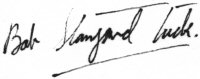 Wing Commander Bob Stanford Tuck DSO DFC** (deceased) *Signature Value : £75 (clipped) | Bob Stanford Tuck was a flamboyant fighter pilot, his dashing good looks, courage, and success in the air coming to epitomise the young flyers who fought and won the Battle of Britain. To the British public he was a hero in the mould of the knights of old, and today his name is legend. In the early stages of the Battle of Britain Bob fought with 92 Squadron flying Spitfires, quickly becoming one of the leading aces. Promoted to command 257 Squadron, now flying Hurricanes, Bobs dashing style of leadership inspired his pilots to great success. He went on to command the Duxford and Biggin Hill Wings, taking his personal score to 29 air victories before being shot down by ground fire over Northern France in 1942. He died on 5th May 1987. |
  Wing Commander George Grumpy Unwin, DSO, DFM* (deceased) *Signature Value : £65 (clipped) | George Unwin joined the RAF in 1929, and in 1936 was posted to Duxford with 19 Squadron as a Sergeant Pilot. He was one of the first pilots in the RAF to fly the Spitfire. With the outbreak of war 19 Squadron moved to Hornchurch and George, now one of the Squadrons most experienced pilots, took part in the great air battles over France and Dunkirk, scoring 3 and a half victories. He flew with 19 Squadron continuously during the whole of the Battle of Britain. He was commissioned in 1941. After a period instructing, he resumed operations, flying Mosquitoes with 16 Squadron. George finished the war with 13 victories, 2 shared, 2 unconfirmed, and 2 probables. He died 28th June 2006. |
 Wing Commander Roger Morewood (deceased) *Signature Value : £55 | An uncle suggested to Roger Morewood that he should join the RAF so Roger did at the age of 17. Roger said : I was going be a pilot, that was the only reason to join. Roger trained to fly in a Tiger Moth biplane before joining 56 Squadron - regarded within the RAF as an elite unit - flying open cockpit Gauntlet fighters. The squadron were then re-equipped with Gloster Gladiators - the last RAF biplane - then the Hawker Hurricanes that would join Spitfires in fighting off Hitlers Luftwaffe in the Battle of Britain. While serving with 56 Squadron Roger Morewood was assigned the dangerous role of long-range fighter sweeps over the coast of occupied France and Holland but left to help form 248 Sqn at Hendon with whom he served throughout the Battle of Britain flying Blenheims. Roger said: We had a few panic station alerts when we were scrambled. We wouldd be leaping into our aircraft with flying suits over our pyjamas as we tried to get into the air in a minute and a half. In July 1942 Morewood went to 9 OTU and later HQ Transport Command. After a long post-war career in the RAF he retired in 1957. Roger Morewood once said of his squadron: It was damned dodgy. We had a high loss rate on operations. And on one sortie - then aged 21 - he nearly met his maker : I flew across to Den Helder (Northern Holland) in a long-nosed Blenheim to look after this battleship at the entrance to the Zuiderzee. We flew round this thing and sure enough I saw some aircraft coming up. They were twin-engine bombers naturally - Messerschmitt 110s. That was a bit hairy. My two blokes (other pilots) shoved off in a hurry into a cloud, and there was me popping away until I ran out of ammunition. There was just me left. I realised there was no point chasing - I was not going to knock his wings off. So I started flying home. After making hardly any noise all flight the chap (navigator) in the back said you haveve got somebody on your tail now - you had better move swiftly. So I moved to left and right. We got a pretty hefty clobbering. His turret disappeared at the back. My poor navigator wore a tin hat and I dont blame him. He got a bullet half way through his armour. He was alright. I had a dreadful wound. If I shook my hand really hard I could get blood out of one finger. I was hit all over the place. We took dozens of bullets. The aircraft was ruined. That is all there was to it. We were still going home - even with the North Sea to go across. So I trundled off back and ditched the damn thing. Thank God it didnt blow up. We literally got away with it. It was the hairiest trip I ever did. On another occasion, Roger intercepted a German weather forecasting flying boat called Weary Willy : I was in a Beaufighter at this time. I flew upwind and had a shot at him downwind. Then all the guns jammed. So I pulled alongside him - not too close - and waved him good luck lad. Anyway he sank when he got back to Norway. That was that one finished. Flying from Shetland, his squadron attacked German shipping off Norway. Roger was rested and spent two years training new Beaufighter pilots but still managed to go on some operations, mainly attacking convoys off the coast of Holland. Roger Morewood said: job was to attack the flak ships, floating anti-aircraft batteries, so other Beaufighters could attack the cargo ships. It could be pretty hairy as 12 Beaufighters lined up to have a crack at the target. You wouldd see tracer shells from your mates plane whizzing over your head or underneath you. They were a bigger danger than the Germans Wing Commander Roger Morwood was posted to the Mediterranean where he contracted TB. He recalled: "In hospital, they treated you with whisky in milk and a pint of Guinness for breakfast, very primitive stuff." When the war ended and the RAF were scaled down, Roger continued to serve in various postings around the UK until 1947. after leaving the RAF Roger was recalled again as an instructor at the Central Flying School, but with the rank of flight lieutenant. He was posted to Edinburgh and then Glasgow University squadrons. finnaly leaving service in 1957. Wing Commander Roger Morewood notched up more than 5000 flying hours in 32 different types of aircraft. Roger Morewood died in early December 2014. |
|
Contact Details |
|
Sign Up To Our Newsletter!
This website is owned by Cranston Fine Arts. Torwood House, Torwoodhill Road, Rhu, Helensburgh, Scotland, G848LE Contact: Tel: (+44) (0) 1436 820269. Email: cranstonorders -at- outlook.com
|
 |




 (clipped)


